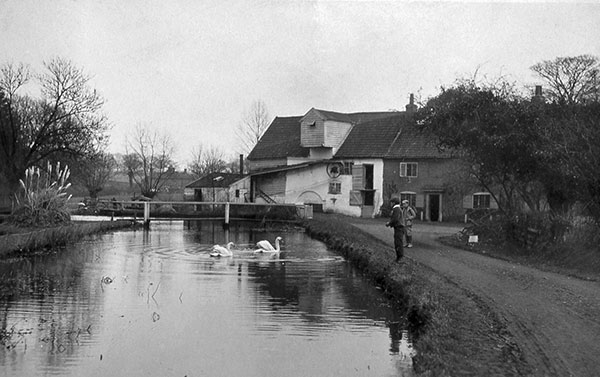
1907
|
Aldborough Mill
Scarrow Beck |
|
1907 |
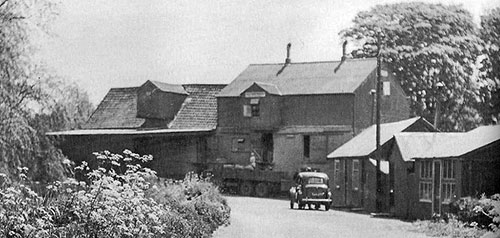
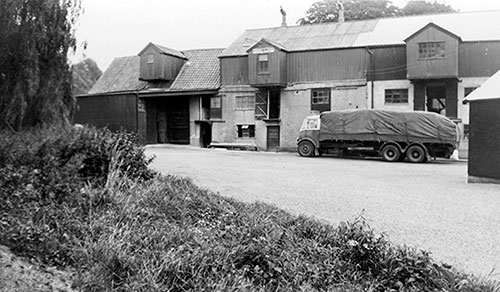
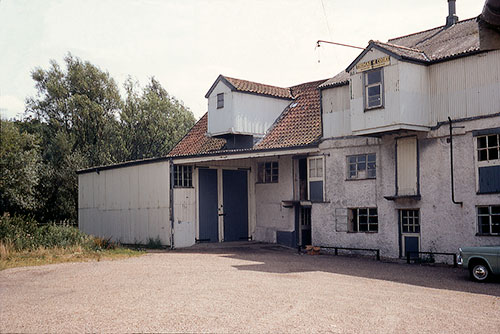
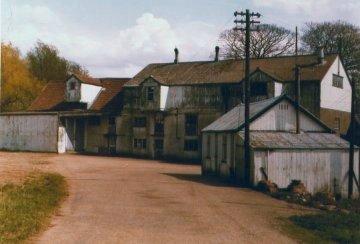
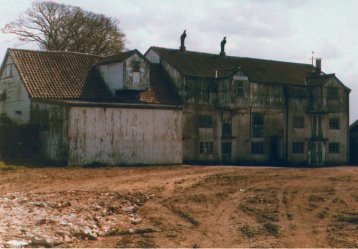
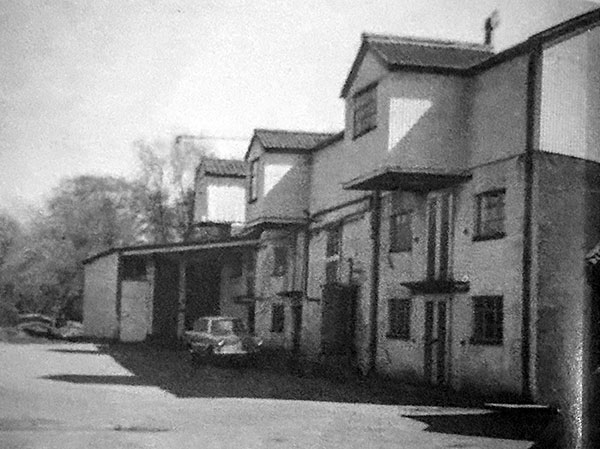
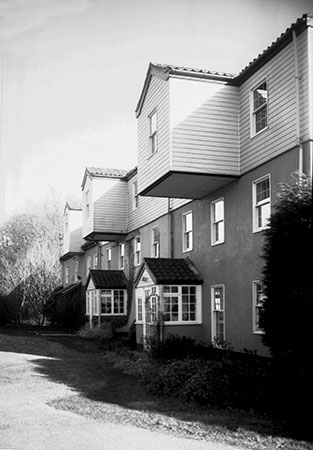
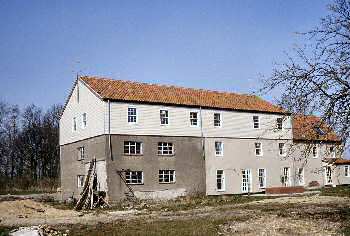
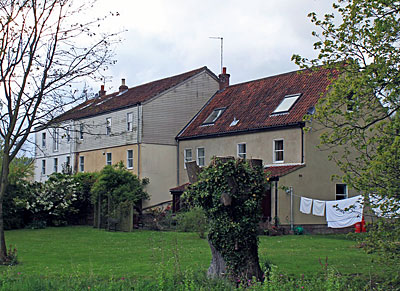
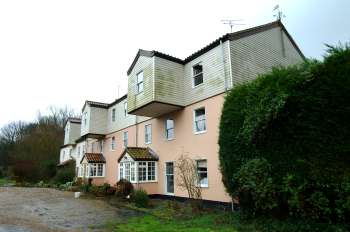
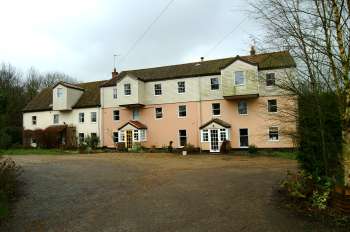
Aldborough mill was on a site that had been in use since before Domesday and every few hundred years a new mill would be built to replace an earlier one. The photographs show that the final structure to be worked consisted of 3 definite sections. The oldest and smaller section was about 150 years old and consisted of mainly white weather board, the newer sections being in brick and then stone. There were 3 lucums, although when the older one went out of use a leanto was built under it. The water wheel was removed c.1930. |
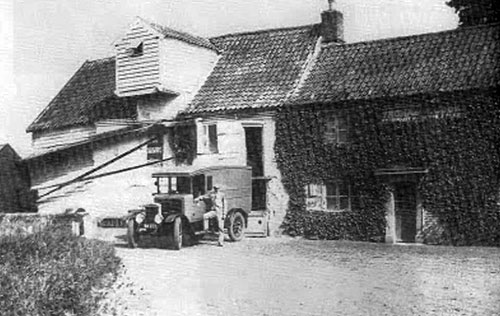 |
Mill running on diesel power c.1935 |
 |
 |
|
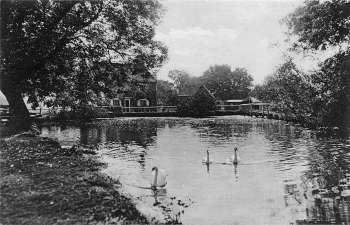
Mill dam c.1907 |
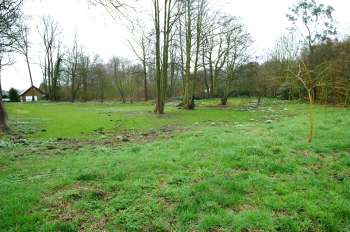
Mill dam January 2003 |
The mill dam
was cleaned and dug out by prisoners of war just after the first World War.
In the middle of the dam, in an area that only be reached by boat, was an
island planted with a myriad of flowers. The nearby watercourses and streams
were crossed by bridges. In the 1950s, the area where the mill dam used to be was bulldozed over and Scarrow Beck was diverted, leaving very little trace of the mill's old watercourse. The section where it went under the mill was bricked up although in 1977 the arch outlines still showed. Some of the machinery was buried in an old gravel pit at the back of the mill. |
Summer Holidays at Aldborough Mill I want to tell you about Aldborough Mill and the people who once lived there. No-one knew the exact age of the mill, but my mother was born there in 1850, when my grandfather had long been established as the miller. I was first taken to the mill at about the age of four, and at least once a year thereafter until old enough to go alone to stay, which I did very often, until the events which I shall describe caused the 'old home', as Mother called it, to be abandoned as a dwelling. He carries on with a detailed description of the house and outbuildings, (which we shall sadly have to omit), continuing with this introduction to the garden: |
 |
 |
|
c.1958 |
1958 |
 |
 |
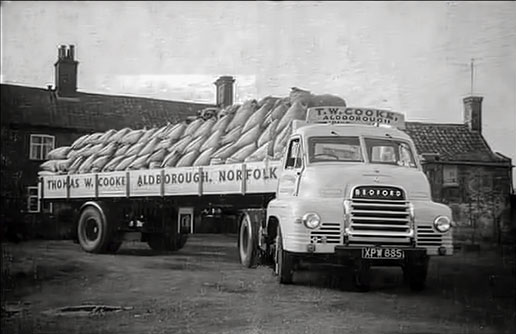
Bedford S Type - c.1955 |
August 1967 |
Indenture: Declaration of the Uses of a Fine. Between Gilbert Parker of Alborough, gent. and Clement Palgrave of the Inner Temple, Esq. Water mill in Aldborough. Seal tag. 8th December 1638 |
 |
 |
|
30 April 1977 |
Mill
frontage 30 April 1977 - older section on the left |
 |
 |
|
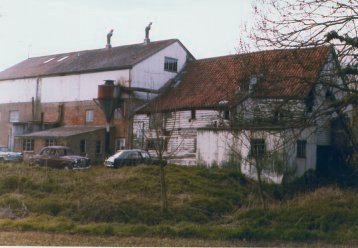
Rear
of both buildings 30 April 1977- no water |
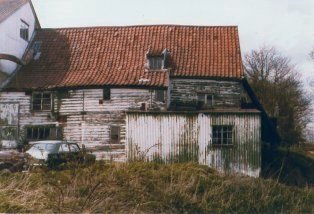
Rear of the old weatherboarded section 30
April 1977 |
When the above
photographs was taken an old French burr stone was still leaning up near
the door on the old section - it can just be seen on the right hand side
of the left hand photo above. |
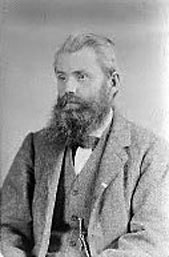 |
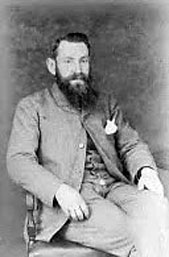 |
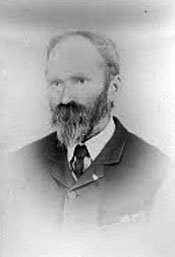 |
 |
William Cooke snr 1895 |
Robins Cooke 1909 |
Henry Carter Cooke 1909 |
Thomas Carter Cooke 1909 |
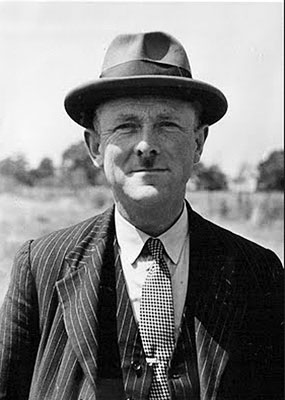
When Thomas Carter Cooke died in January 1917, his 20 year old son Thomas William Cooke was called back from the war to take over the running of the mill, as milling was a reserved occupation. Thomas brought a great energy and in spite of the depressed rural economy, he vigorously pursued many business opportunities. Thomas senior brought up his two sons within a considerable non-conformist religious zeal and young Thomas expressed a similar attitude in both his business and personal life. At first, Oliver resisted the faith but later came round. |
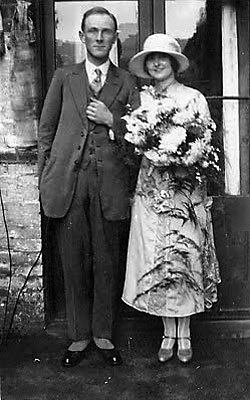 |
 |
|
Thomas William Cooke on day of his wedding to Hilda Thirza |
Tom Cooke c.1960 |
| Thomas William Cooke was born on 19th June 1897 at Thwaite. He married Hilda Thirze. Hilda Cooke died on 9th February 1989. Thomas Cooke died on 2nd June 1989. |
|
Much of the
information herein was gleaned from Thomas William Cooke, whose brother, father and
grandfather were millers here. The mill came into their family in 1809
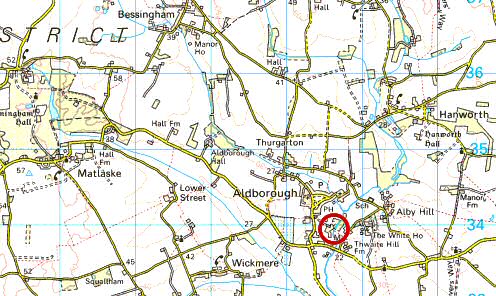
and they later went on to own 4 others. The mill stands on the joint parish
boundaries of Aldborough, Alby and Thwaite but is known as Aldborough
as it is closest to that village. At this time the mill was running 3 pairs of stones - one for flour and two for grist. The grist stones were too sharp to grind wheat, which needs to be rubbed rather than cut. Towards the end carborundum stones were used as the original French buhrs were worn too badly. |
Aldborough Mill Memories In their young days, the brothers displayed a spirit of invention in many areas. Mary Carpenter (née Cooke): They used to make fireworks as well, in the shed behind the mill ... the two Cooke brothers always did a display on Aldborough Green. I've got a book of theirs with recipes on how to make fireworks ...
Here's an authoritative comment from someone who witnessed the exploits of the brothers Cooke over many decades. Oliver Cooke had a bungalow built for his family just over the way from the mill, and his four children, David, Jean, Mary and Jonathan grew up there. Jean has some tales to tell. To a small child all that water in the millpond was very unfriendly and the sluice was particularly frightening. There was a very old punt that David used to use on the pond and Dad before him; you had to manoeuvre this very long pole down into the mud and push yourself along. I remember the pond being frozen many winters, and we could walk across to the three islands and pick the snowdrops. People came to skate on the ice, but there was a dangerous bit near bridge that never froze over properly, where the water ran down a into the stream. Uncle Tom kept pigs for a time, and ran a series of trials with pig feed. There must have been 6 pigsties, and as a 3 yr old, I loved playing in with the pigs. Each pig was being fed differently. But one day, I decided to unbolt all the gates, and they all ran out and into the meadow. Poor Uncle Tom and his pig-man nearly went spare but one of them hit on the idea of rattling their feeding troughs, and they all trotted back into the right sty! On another occasion I rode bareback on a big old sow. She came straight for me, and I landed back to front on her, hanging on to her tail. We used to climb down the bank of the stream just behind the mill and float pieces of wood, but if the men saw us, just for a bit of fun they'd release the sluice and the water would come gushing outs we'd hastily scramble up the bank, I can tell you! We had great times with the old sack trolley - big enough to hold - 6 of us. We'd push it up to the top of the hill, jump in, and with David steering, we'd career round the back of the mill; David always managed to stop it just before it went over into the stream. |
c.1944-45 a
Mr. Green was the miller working for Thomas Cooke and many of the staff
took after their employer, who was extremely religeous. One such worker
was Spring Heel
Jack McComb who lived in a caravan behind the mill and was so named as he
had an affliction causing him to walk in an unusual manner. |
 |
 |
c.1981 |
2nd March 1997 |
 |
 |
|
Rear
of mill just after conversion 15th April 1983 |
2009 |
Just above the
mill is the junction of 2 streams, one from Aylmerton and one from West
Beckham, these flowed into what was once a large mill dam. However the water
drop was not very great and the mill frequently suffered from a chronic
shortage of water, thus a steam engine was brought in to supplement the
power while the water was collecting and this actually provided twice as
much power. By 1957 Scarrow Beck had been returned to its original course bypassing the mill. |
The waterworks at Metton used a lot of water from the area - Mr. Cooke said there were 3 tunnels forming a triangle in the clay, they were 200 feet down and each was 100 feet long. |
 |
 |
|
25th January 2003 |
25th January 2003 |
Insolvent Debtor. Prisoner for Debt. |
| In 1977 the mill was still being worked occasionally by its Kenyan owner Mr. Patak, grinding oriental spices such as coriander and cumin seed, which came in directly from the docks. The seeds were crushed using a hammer and stone arrangement powered by the Crossley diesel engines. |
The Cooke family ended up buying the site in the 1800's and went on to run other mills in the area, with my grandfather inheriting the Aldborough Mill operation when he was 21 in 1920 - pulling him back from service in the first world war as milling was a reserved occupation. |
 |
O. S. Map 1885 |
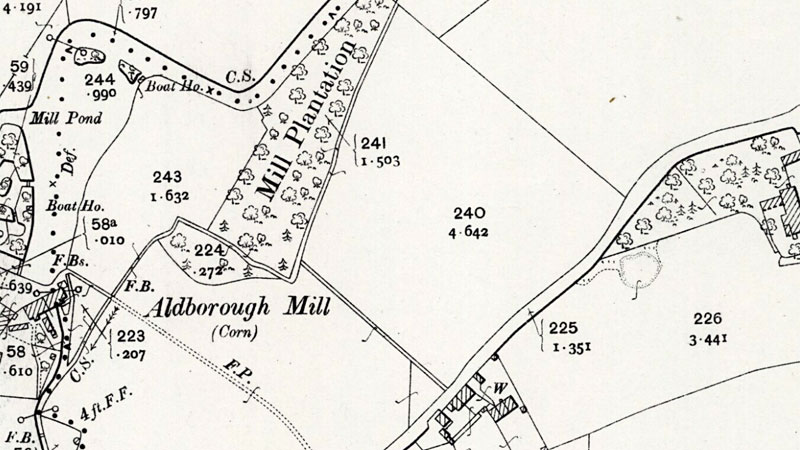 |
O. S. Map 1905 |
 |
O. S. Map 1956 |
 |
|
8th December 1638: Indenture between Gilbert Parker and Clement Palgrave
White's 1845: Richard Clarke & Mrs. S.T. Clarke
White's 1854: William Cooke, corn miller Kelly's 1892:
William Cooke, miller (water & steam) |
If you have any memories, anecdotes or photos please let us know and we may be able to use them to update the site. By all means email or telephone 07836 675369. |
| Nat Grid Ref TG1860 3393 | Copyright © Jonathan Neville 2003 |